
An educational initiative may begin with an honest observation: students read without discussing meaning, employees complete courses but return to old practices, or knowledgeable teachers lack time and support to experiment. An idea, appealing name, platform or training pack follows. The harder test comes after launch: did anything change worth sustaining, and can the experience be delivered again at the same quality?
As used here, initiative engineering bridges intention and outcome by connecting needs diagnosis, learning design, operations, resources, partnerships and measurement. It asks what system makes desired change possible and supports its persistence and expansion.
This article combines Saudi sources and international research, translating them into decisions for schools, academies, training companies and funders. Calculations and the later practical case are hypothetical illustrations; research and report figures retain their sources and dates.
The central idea
Value emerges when a team knows whom it serves, what it wants to change, why change is expected, and how to support, verify and finance it over time.
1. Saudi context: broad ambition needs precise initiative design
Saudi Arabia's capability agenda spans early childhood through lifelong learning. The official announcement of the Human Capability Development Program's 2025 report, published on 14 June 2026, reported training more than 13,000 teachers in AI and its applications, and launching a national professional development platform reaching over 470,000 trainees. These are reported activity and reach figures. They raise a design question: how should participants' workplace use of learning be followed up? [1]
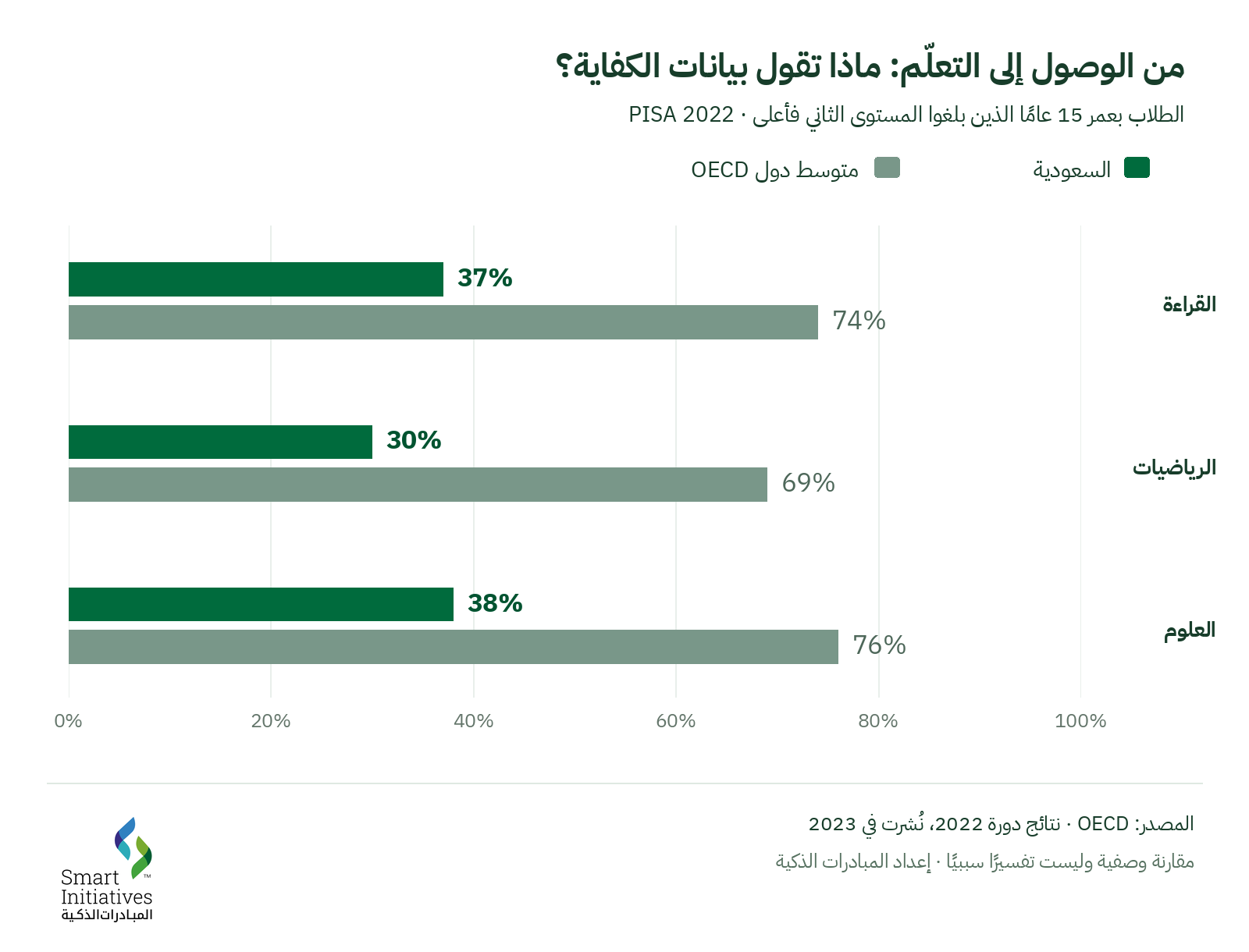
Learning data underline this question. In the PISA 2022 cycle, 37% of participating Saudi 15-year-olds reached reading proficiency Level 2 or above, compared with the OECD average of 74%. Mathematics figures were 30% and 69%, and science 38% and 76%. These cycle-specific results, published in 2023, do not directly measure 2026 attainment or explain causes or an individual school's performance. [2]
Choose initiatives around performance to improve. For reading comprehension, specify identifying main ideas, connecting evidence or interpreting authorial stance. For job readiness, identify the difficult task. This creates a testable starting point rather than turning a broad national priority into a generic event of uncertain value.
2. Diagnose the problem before choosing the solution format
Development requests often name a product: a platform, programme or academy. Treat that as an initial solution hypothesis. Before fixing scope, describe the gap participants face and the conditions sustaining it.
A centre seeking better report-writing among new employees might assume a writing course. Work samples may instead reveal unclear report purposes, missing data or inconsistent departmental templates. The solution may combine task clarification, process improvement, training and manager review. Early diagnosis changes both the build and partner expectations.
Three evidence layers provide a serious starting point
Performance evidence: Work samples, diagnostic tasks or assessments locating difficulties. Participant voice: Brief interviews exploring what feels difficult and what has already been tried. Implementation context: Available time, language, devices, support, incentives and people authorised to change procedures. Combining these layers distinguishes skill gaps from environmental barriers.
Across Saudi regions and groups, access times, equipment, facilitator experience and family needs may differ. Limited interviews and samples can start the process if their boundaries are stated and unheard groups sought. Representation depends on relevance to design decisions and diversity of conditions, not interview count alone.
This stage's deliverable
Write one page identifying the audience, difficult task, evidence, possible barriers and information still needed before choosing a solution. If that cannot be done clearly, further diagnosis is needed.
3. Build a testable explanation of change
A theory of change connects activities with expected participant outcomes. J-PAL places review of programme goals and how they are achieved at the start of evaluation design, explaining how the model clarifies logical steps and testable assumptions. [3]
A reading initiative might provide suitable texts, a skilled discussion facilitator and regular practice time; students engage in guided reading, dialogue and summarising; the team then looks for improved inference and expression. Assumptions include attendance, appropriate difficulty and feedback that helps address errors.

Examine transitions: how will watching a video produce skill? Is there practice and reviewed work? How will competence in the programme transfer to school or work? Manager approval, process change or continued guidance may be needed.
Clear links make it easier to choose measures, initial tests and partners. Design changes become understandable: a particular assumption is revised because evidence exposed weakness, rather than adding more content whenever problems arise.
4. Design learning that changes practice
Distinguish what learners see from what they do. Clear content alone may not enable application. Start with required performance, then create tasks that reveal and develop it: case analysis, performing a step, work samples or explaining decisions, with feedback and another attempt.
A 2017 Learning Policy Institute review analysed35 methodologically rigorous studies showing positive links between professional development, teacher practice and student outcomes. Shared features included content focus, active learning, collaboration, modelling, coaching, feedback and reflection, and sustained duration. These are features of reviewed programmes, not guarantees that any single addition produces the same effect everywhere. [4]
For Saudi reading facilitators, this could mean observing a model session, designing questions for an Arabic text, testing with a small group, receiving feedback on questions and student discussion time, then trying again. The training pack becomes a reference within practice; evidence is what facilitators and students actually do.
Technology serves the learning task
National eLearning Center standards stress alignment of content, activities and assessment with outcomes, alongside support, accessibility, governance and clear roles and policies. They provide an important local reference for digital or blended experiences. [5]
For each digital feature, ask whether it supports placement, feedback, difficulty monitoring or access. Defer features without a clear function until testing reveals need. Test Arabic and mobile usability, completion within available time and access to help.
5. Implementation quality belongs in the design
Define what each person does, when, with which tools and how exceptions are handled. Strong materials may still fail through delayed communication, inconsistent facilitation or no dropout response. Write and test the operating guide while developing the programme.
EEF's updated 2024 guide combines participant behaviours, contextual factors and structured implementation through four flexible stages: Explore, Prepare, Deliver and Sustain. It emphasises engaging people, building shared understanding and reviewing work alongside resource and plan preparation. [6]
A lesson from repeated testing
J-PAL documents Pratham's Teaching at the Right Level approach. Across six randomised evaluations in seven Indian states , the approach proved effective when systematically implemented: assess learner levels, offer suitable activities and monitor progress. The evaluation synthesis found teacher training or materials alone insufficient in tested models; clear goals, mentoring, support and monitoring mattered. [7]
For Saudi teams, test the support system alongside content. Indian results are not numerical forecasts for Saudi Arabia, nor are curricula and conditions identical. Ask what practitioners need to implement the approach: protected timetable space, observation or brief reviews of student work.
It helps to distinguish core components from adaptable components. Diagnosis, practice and feedback may be essential, while schedules, examples and communication can vary. Document why each adaptation is made and review its effects. Flexibility then supports quality, and site differences become structured learning opportunities.
6. Give every partner a role linked to value
Initiatives may involve educators, academic partners, funders, operators and technology providers. Specify each party's contribution, obligations and authority to resolve problems. A university name alone does not determine content-review responsibility, nor funding who follows up after the initial grant.
The Partnering Initiative's framework, developed with organisations including UN DESA, focuses on collaboration's additional value and each partner's gains compared with acting alone. This is useful before announcing a partnership. [8]
A local educational initiative can use a simple matrix: the educational body selects sites and provides time; the academic partner reviews learning and assessment; the operator manages schedules, facilitators and support; the funder links payments to agreed stages. Also settle knowledge ownership, updates, data boundaries and decisions when priorities conflict.
Before launch, simulate difficult cases: an absent facilitator, a withdrawing site or a learner needing support beyond scope. These expose operational readiness and prevent important decisions being improvised under delivery pressure.
7. Measure change, then ask what can be attributed to the initiative
Indicators answer different questions: registrations show reach, task completion engagement, work assessment performance and later follow-up continued use. Name each accurately so attendance does not become proof of mastery or satisfaction proof of learning impact.
| Level | Example indicator | What does it help explain? |
|---|---|---|
| Reach | Participant numbers and distribution across sites and groups | Who was reached and who remained excluded |
| Delivery | Sessions delivered and quality of practice and support | Whether delivery followed the design |
| Learning | Performance on comparable tasks before and after | Observed change in knowledge or skill |
| Application | Use of the skill in a real task after the programme | Transfer to the intended context |
| Impact | Change whose relationship to the initiative can be estimated through suitable evaluation | Added value while examining alternative explanations |
OECD evaluation criteria offer six complementary perspectives: relevance, coherence, effectiveness, efficiency, impact and sustainability. A programme can achieve its goals yet still need reconsideration before expansion because of cost or poor reach among those most in need. [9]
Pre/post improvement alone does not prove causation. Repeated testing, other learning or differences among assessment completers may matter. Agree comparisons, instruments, marking and missing-data handling beforehand. Seek specialist support for causal estimates informing major decisions; J-PAL links evaluation questions with theory of change, allocation and measurement. [3]
Not every stage needs a large experiment. Early questions may concern facilitator delivery and student understanding: feasibility and implementation quality. Once the model stabilises, outcome and attribution studies become more useful. Match evidence to decisions and state what data do and do not establish.
8. Calculate the cost of value, including work behind the scenes
Sustainability starts with actual resource use. Beyond content and delivery fees lie diagnosis, coordination, mentoring, support, assessment, updating and host time. Scaling may lower content-development cost per person while individual follow-up still grows with numbers.
The 2023 Global Education Evidence Advisory Panel Smart Buys report stresses comparing cost with learning. The World Bank announcement says the work screened over 13,000 research papers, focusing on low- and middle-income countries. It supports teacher assistance and instruction matched to learner level, and cautions against devices without supporting components. Use this logic to examine the intervention package, while building local cost and outcome estimates before applying it to Saudi projects. [10]
A calculation that changes how we read budgets
Suppose, purely illustratively, SAR 120,000 targets 200 participants: SAR 600 per intended seat. If 160 complete, cost is SAR 750 per completion; if 120 meet a predefined performance standard, it is SAR 1,000 per achieved standard. These denominators answer different questions and should appear together rather than selecting the most attractive figure.
The final indicator is not cost per causal impact, since other factors may affect attainment. It does help locate losses: before starting, during delivery, or retaining people without achieving performance.
Then examine funding through participant fees, institutional contracts, sponsorship or a mix. Test affordability, acquisition costs, quality requirements and continuing partner commitments. Financial sustainability is an operating-model decision requiring periodic review as volumes and services change.
9. A hypothetical Saudi school reading-comprehension initiative
An illustrative design case, not a delivered project or actual Smart Initiatives results. Numbers and durations are assumptions for discussion, to be revised after diagnosis.
Suppose an organisation pilots with 200 students in four schools and 20 teachers. An initial goal of stronger engagement with reading narrows to drawing an inference from a short Arabic text and citing supporting evidence.
Decision one: what improvement is worth tracking?
Before materials, design two similarly difficult tasks: students read, state an inference, select evidence and explain the connection. Two assessors pilot clear marking criteria on sample answers. Agree target performance and how improvement will be examined without promising numbers before the baseline.
Decision two: what experience could support that improvement?
The proposed journey combines guided reading, teacher think-alouds, student discussion, brief writing and evidence review. Select linguistically and culturally suitable texts across topics and graduated difficulty. Facilitators invite explanations and retain work samples showing development.
Decision three: how will teachers and time be supported?
Teachers begin with practical workshops using the same texts, then test brief sessions and receive feedback. Agree delivery time, monitoring and a site coordinator with schools. Review samples of sessions and work to locate issues in text suitability, discussion, time or assessment understanding.

An initial 90-day framework
| Period | Main activity | Evidence needed for the next step |
|---|---|---|
| Days 1–15 | Diagnosis, work samples and dialogue with schools and teachers | Shared definition of the skill, audience and barrier |
| Days 16–30 | Materials and assessment design, trial session and facilitator preparation | Deliverability and understanding of assessment and roles |
| Days 31–75 | Pilot delivery, teacher mentoring and regular reviews | Delivery, participation, adaptation and performance records |
| Days 76–90 | Analysis of results, costs and site differences | Documented decision: revise, repeat or expand cautiously |
Plan later follow-up for sustained practice as calendars allow. Coordinate data collection and consent with schools, minimise personal information and present analysis in ways that protect participants.
Some sites may deliver consistently while others struggle with schedules. Regular attendees may improve while dropout outcomes remain unclear. The next decision may be to improve access and consistency and repeat testing. Expansion requires evidence that the model works under less ideal conditions.
10. Scale when you can explain what works and what needs support
Scaling changes the initiative. Original designers become more distant, new facilitators need preparation and participant circumstances vary. Growth plans need knowledge transfer, monitoring of core components, updates, problem resolution and continuing funding.
Brookings' 2023 report analysed six cases from Real-time Scaling Labs through documentation and participatory research from 2018–2023. It treats scaling as contextual, collaborative and adaptive across system, institutional and individual levels. These comparative experiences illuminate conditions, not a universal success rate. [11]
A decision brief can cover participant change, delivery quality, underserved groups, costs of maintaining standards and responsibility at doubled volume. Include site differences so averages do not hide success in one location and difficulty in another.
The next step might add two contrasting sites, prepare another team or transfer operations to a partner with supervision. Its value lies in testing sustainability and transfer. Documented reasoning helps teams preserve what works while adapting to context.
Can you explain your initiative on one page?
Bring the team together to define audience, need, intended change, proposed experience, assumptions, partner roles, measurement and first-cycle costs. Discuss evidence for each choice and identify the most important question to test now.
Smart Initiatives helps organisations connect diagnosis and experience design with operations, partnerships and measurement. Send your idea, intended audience and desired outcome so we can discuss an appropriate development approach.
Discuss your initiative's designWatch and explore
Two English-language videos complement this article. Watch here or on YouTube and visit the producing organisation's page.
How do implementation elements work together?
A visual introduction to team behaviours, context and implementation stages. Ask what support your initiative's team needs.
What changes when an educational initiative scales?
A discussion of scaling-lab experience across countries. Consider partner roles and contextual adaptation alongside your project's scaling assumptions.
Sources & References
Sources accessed on 28 September 2026. Ideas are analytically paraphrased; practical examples and proposed designs remain Smart Initiatives' editorial responsibility. Data years are stated when different from publication dates.
- Human Capability Development Program / Saudi Press Agency. (14 June 2026). Human Capability Development Program highlights its 2025 achievements. Used for national capability-development direction and reported 2025 activity figures.
- OECD. (2023). PISA 2022 Results (Volume I and II) — Country Notes: Saudi Arabia. PISA 2022 data for 15-year-olds; Level 2-or-above rates in reading, mathematics and science.
- Gibson, M. & Sautmann, A. / J-PAL. The elements of a randomized evaluation. Methodological resource on theory of change, measurement and evaluation design.
- Darling-Hammond, L., Hyler, M. E. & Gardner, M. (2017). Effective Teacher Professional Development. Learning Policy Institute review of 35 studies; professional development design features used.
- National eLearning Center. eLearning Standards. Version available at access, used as a local reference for learning, assessment, support and governance.
- Education Endowment Foundation. (2024). A School’s Guide to Implementation, third edition. Supplemented by the implementation stages overview andthe explanatory video published in December 2024.
- J-PAL. (updated August 2022). Teaching at the Right Level to improve learning. TaRL evaluation and development synthesis, explaining support and monitoring without transferring effect sizes to Saudi Arabia.
- The Partnering Initiative / UN DESA. Maximizing Partnership Value Creation Guidebook. Partnership added-value framework used as a design tool.
- OECD. (criteria updated 2019; application guide 2021). Evaluation Criteria. Relevance, coherence, effectiveness, efficiency, impact and sustainability.
- Global Education Evidence Advisory Panel / World Bank. (2023). 2023 Cost-Effective Approaches to Improve Global Learning — Smart Buys. Report announcement and summary; scope is low- and middle-income countries.
- Wyss, M. C., Elliott, M., Robinson, J. P. & Qargha, G. O. (2023). Scaling impact in education for transformative change. Brookings analysis of six Real-time Scaling Lab cases, with the accompanying webinar recording.